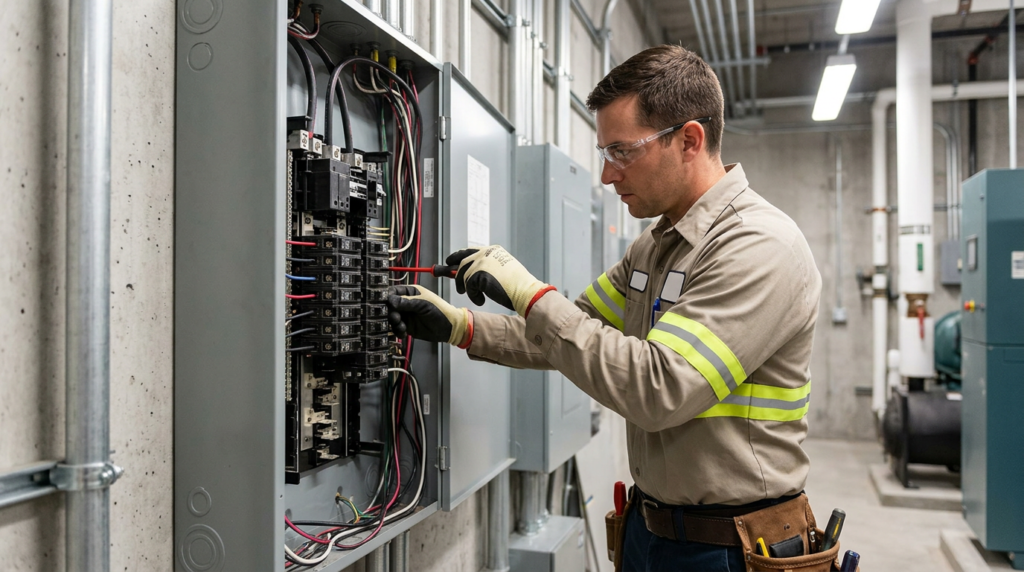
Quick answer: Call a licensed commercial electrician for power distribution, panels, circuits, lighting, controls wiring, and code-required repairs or upgrades. If the electrical issue is tied to HVAC or refrigeration equipment—like a unit tripping breakers, a failed disconnect, or control-voltage problems—start with an HVAC service company that can coordinate with an electrician. The right choice depends on whether the fault is building power or the equipment itself.
Start by separating building power from equipment problems
Most “electrical” complaints in a commercial space fall into two buckets: building electrical (panels, feeders, branch circuits, lighting) and equipment electrical (motors, contactors, relays, transformers, control boards). If lights flicker across multiple areas, breakers trip without a clear pattern, or you smell hot insulation near a panel, you’re in building-power territory and should involve a commercial electrician.
If the issue shows up only when an HVAC or refrigeration unit starts—like a rooftop unit tripping a breaker, a condenser fan not starting, or a compressor that hums and shuts off—the problem may be inside the equipment. In that case, it’s reasonable to begin with an HVAC technician who can diagnose the load and controls, then loop in an electrician for supply-side repairs. Many people searching DuPont commercial electrical services are really trying to solve a comfort or cooling failure that happens to present as an electrical symptom.
A quick rule of thumb: if the disconnect, breaker, or panel is the suspected failure point, call an electrician first; if the unit’s internal components or low-voltage controls are suspected, call HVAC first.
Common commercial electrical tasks (and what they affect)
Commercial electrical services usually cover installation, repair, and troubleshooting for service panels and subpanels, breaker and fuse issues, dedicated circuits for equipment, lighting and emergency/exit lighting, receptacles, and basic control wiring. They also handle code-related corrections like missing disconnects, improper conductor sizing, loose terminations, and damaged conduit.
Electrical problems often show up as heat, noise, or repeated resets. Warm breaker handles, buzzing from a panel, outlets that discolor, or a burning odor are red flags to shut down the affected circuit and get help. Loose connections can create arcing, which can damage equipment and raise fire risk.
If your space has three-phase power, motor loads, or a lot of refrigeration, an electrician can also help evaluate phase imbalance, failing contactors, and power quality issues that can shorten motor life. Those checks pair well with HVAC diagnostics when the complaint is “the unit keeps shutting off.”
What to have ready before the service call
Having a few details ready can speed up troubleshooting. Note which areas are affected, what was running when the problem happened, and whether it’s tied to weather, time of day, or a specific piece of equipment. If you can do so safely, record the breaker number, panel location, and any error codes shown on thermostats, controllers, or refrigeration racks.
Also share any recent changes: new equipment, remodel work, a tenant build-out, or repeated breaker resets. Repeatedly resetting a breaker without fixing the cause can damage the breaker and the wiring, and it can mask an overheating condition.
If food safety or critical operations are on the line, say so up front. That helps the contractor prioritize temporary stabilization steps—like verifying disconnect condition, checking contactor operation, or confirming proper airflow and condenser cleanliness—while planning the full electrical repair.
How Nextech fits in when HVAC and electrical overlap
Many commercial comfort and cooling failures look electrical at first: a transformer failure can kill a thermostat, a contactor can keep a compressor from starting, and a failing motor can trip a breaker even if the building wiring is fine. An HVAC-focused diagnostic can identify whether the equipment is overdrawing current, short-cycling, or failing to start under load.
If the root cause is on the building side—like an undersized circuit, a loose termination, or a bad disconnect—an electrician is still the right trade for the repair. A good handoff is one where the HVAC tech documents what the unit is doing (and drawing) so the electrician can fix the supply-side issue confidently.
If you’re in DuPont and the problem involves heating, cooling, or refrigeration equipment that’s acting like an electrical fault, Nextech is a practical starting point to get the diagnosis moving and coordinate next steps.