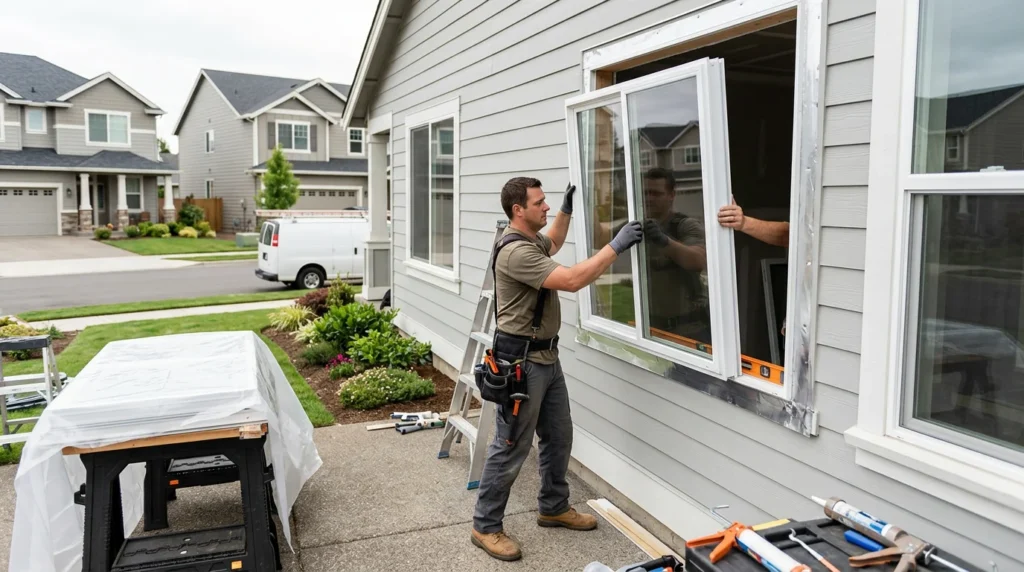
Quick answer: Pick a local window replacement company by focusing on process, not promises: confirm they measure each opening (not “standard sizes”), explain what happens to trim and siding, and specify the exact window line and glass package in writing. Ask how they handle rot, water damage, and disposal. A clear installation plan, realistic lead times, and a workmanship warranty you can read up front prevent most surprises.
What To Ask Before You Schedule An Estimate
Look for an installer who can explain their process clearly and put it in writing. If you’re typing window replacement service near me, use that search as a starting point, then screen companies by how specific they are about measuring, installation steps, and what’s included.
Ask whether they do an in-home measurement for every opening and whether the quote is based on those measurements. Confirm what’s included: removal of old windows, disposal, interior and exterior trim work, caulking, and any paint or stain touch-up. Request the exact window model, frame material, and glass package in writing (for example, double-pane vs. triple-pane, low-E coatings, and whether grids are between the glass). Also ask how they handle hidden damage like soft wood, moldy sills, or out-of-square openings—reliable contractors typically describe a plan and a change-order process before work begins.
Phone Call Checklist (Yes/No)
Use these yes/no questions on every call so you can compare quotes without guessing:
1) Will you measure each opening on-site before final pricing (not just count windows)?
2) Will you tell me whether you’re proposing full-frame replacement or insert/pocket replacement?
3) Will you describe your flashing approach (how you manage water at the opening)?
4) Do you have a written change-order policy for rot or hidden damage?
5) Is removal and disposal of old windows included?
6) Will you protect floors/furniture and handle daily cleanup?
7) Will the quote list the exact window model/series and glass package in writing?
8) Can I read the workmanship warranty document before I pay a deposit?
Repair Vs. Replacement: Specific Decision Triggers And A Simple Next-Step Flow
Repairs are often reasonable when the window is structurally sound and the problem is limited to parts. Examples include worn weatherstripping, loose locks, crank operators on casements, tilt latches, or sash balances that no longer hold the sash up. If the frame is solid, the sash still fits squarely, and there’s no recurring water staining, a targeted repair can buy time.
Replacement is more likely when multiple “failure modes” stack up: a failed insulated glass unit (fogging or moisture between panes), soft/rotted wood, repeated water intrusion around the opening, or frames that are noticeably out of square and won’t seal even after weatherstripping and hardware adjustments. In many cases, you can replace just the insulated glass unit (IGU) inside an otherwise healthy sash, but that’s different from trying to “reseal” a failed IGU in place; IGU replacement is a parts-and-labor job, while resealing a failed unit typically doesn’t restore long-term performance.
What to do next: (1) Identify the main symptom (fogging, drafts, sticking, visible rot, or water stains). (2) Ask one contractor about repair options and one about replacement, using the same checklist so the scope is comparable. (3) If there’s any sign of water intrusion (staining, soft wood, peeling paint), prioritize an in-person inspection and a written plan for flashing and trim, since stopping water is usually the real fix.
Installation And Quote Details That Prevent Surprises
Most homeowner headaches come from unclear scope. Ask whether your project is a full-frame replacement (old frame removed to the rough opening) or an insert/pocket replacement (new unit set into the existing frame). Full-frame work often allows a fresh flashing approach and can address hidden rot, but it typically changes trim work more. Inserts can be less disruptive, but they generally rely on the existing frame being square, solid, and well-flashed.
Ask for a plain-English explanation of water management: how the opening will be flashed, how sealing is handled at the perimeter, and what trim gets replaced versus reused. Also ask what insulation method they use around the frame; low-expansion foam is common, but it needs careful application to avoid putting pressure on the frame. If you want a straightforward way to compare options, request a measurement-based, written scope from Georgia Home Windows and review it against the same checklist you use for other quotes.